Should you base your characters on real-life people?

‘If they’re based on somebody else, in a funny way it’s an infringement of a copyright. That person owns his life, has a patent on it. It shouldn’t be available for fiction,’ said author Toni Morrison in a recent interview with The Paris Review.

Which got me thinking, do I ever copy from life?

I use aspects of things – situations, people’s personality quirks, the way they look. I apply a heavy dose of imagination then write.

To put it the Maggie O’Farrell way: ‘I think all fiction is a patchwork of things you borrow, things you lift from real life and others you simply make up.’

To copy directly would be plagiarism, right? And a tad risky. I mean look what happened to novelist Gregoire Delacourt when a court ordered him to pay actress Scarlett Johansson 2,500 euros for his ‘demeaning’ depiction of a female lookalike in his book The First Thing We Look At.

And although few of these cases get as far as court, writing is a risk. Ablene Cooper, a housekeeper for the family of the brother of The Help author Kathryn Stockett filed a suit. Cooper claimed that her image and likeness had been used without permission for one of the main characters, Abileen Clark. The case was dismissed because the one-year statute of limitations had elapsed.

If my book ever makes it into print, I wonder who’ll be looking for themselves in the margins. My mum is convinced I’ve used her personality for my central character. ‘I haven’t,’ I said. ‘Ya wee devil,’ she replied. I might add that not once does my main woman say ya wee devil. Hailing as she does from the Philippines, it’d be completely out of character. She does however give everyone nicknames (like my mum). A work colleague of my mum’s whose wayward hair failed to stay in a daily chignon became Bird’s Nest. A neighbour became Margaret with the Dug, to distinguish her from the five other Margarets living on the street. Probably best not to mention The Space Cadet or Whhhhhhhy Me????? at this juncture, but the point is, my mum can see herself in my main character.

Some of the people who’ve read earlier versions of the book, reckon my other main character, Juliet, is me. But a couple of months ago, a literary agent, who was admittedly giving me positive feedback at the time, confessed, ‘Juliet’s too wet for me to really care about her.’ Ouch. Out came the drying-up cloth, and in went optimism and some classic lines delivered by one of my best friends. (She’s bound to recognise them). For the record though, Juliet isn’t my friend, neither is she me. I haven’t ever given anyone mouth to mouth resuscitation like Juliet although I did practise on a plastic model when St John Ambulance came to our school once. There was dribble involved.

The few times I’ve tried to write a character based entirely on a person I’ve known, it simply hasn’t worked. Writing like this is a dead end (for me). Copying people is like trying to copy another writer’s style – it just leads to bad writing – oh, and lawsuits.

So best stick to the tried and tested method. Let real events and people send your imagination into a spin, then invention will do the rest of work.

How NOT to write a synopsis

Writing a synopsis is variously described as ‘synopsis hell’ and ‘the most difficult 500 words you’ll ever write’ – in my case, the most difficult 800.

I’ve just written a new synopsis for my first novel, so thought I’d share my pain, ahem, I mean pointers.

Is a synopsis going to land you an literary agent?

Most submissions require a covering letter, the first three chapters of your book and a synopsis. An agent will read your covering letter, take a look at the first few pages of your novel and if they like what they see, they’ll want to know where the story is going; does it have enough meat on it; will it sell? Move over chapters; make way for the synopsis.

What is a synopsis?

It’s not the blurb on the back of the book; it’s the nuts and bolts of your story. What happens; what’s at stake and how does the jeopardy rise? Is the ending a satisfying one?

Here are some other essential ingredients:

  • Hit the highlights – the bones of the story – beginning, middle and end.
  • Make sure the plot has a true arc – are the conflicts of the main characters clear, and the resolutions to those conflicts?
  • Mention the genre of your book – commercial, YA, book group fiction etc.
  • Include setting – what country, what year?
  • Highlight the main characters. Put their names in capital letters or embolden them when you first introduce them.
  • Include the unique selling point of your book.
  • Make the synopsis 500 to 800 words, and when you get an agent who wants a synopsis of 300 words instead, put your head into your hands and blub loudly. Then dab yourself down. You can do this! Chop, chop – take out another subplot or two and get rid of superfluous spiel.
  • Spoilers – Do include the final plot twist.

What shouldn’t you include?

  • A detailed account of the characters’ personalities. A quick character sketch is enough. Disillusioned science teacher Walter White. The unmarried Frances with an interesting past etc.
  • A blow-by-blow account of every single subplot. Be lean; you don’t have the space for this.

Finally, let other people read your synopsis because if Great Aunt Iris can’t make sense of it, you can bet your life a literary agent will chuck it into the bin faster than you can say Trash.

What it’s like to finish writing a novel

It’s almost time to send my first novel out into the world again. There’s nothing left to write on its pages.

There was the first draft. Then a literary agent met me and suggested changes. Next, came the second draft.

When the rejection came, I pushed the book into a drawer for a few months. Then somehow the book started niggling at me again. I found the will to push on with the third draft.

Another literary agent liked it, and what happened was this: a major rewrite and a new plot, resulting in draft number four. Cue good reactions from several literary agents, but still an all-round no.

Then one of the agents wrote back to me recommending an editor/mentor, and with her insights I’ve now completed the fifth draft. Let’s hope this draft is fabulous number five.

When Hannah Kent finished Burial Rites, she had a surprising reaction. (Admittedly this was her first draft, not her fifth).

‘I realised I no longer knew what to write. There was nothing more to write. I pushed my keyboard away from me, read the last line over and over, and then – unexpectedly – burst into tears. They weren’t tears of elation or disbelief. I was suddenly, profoundly sad.’

I can relate. Finishing feels like a loss. I’m glad that I’ve got this far, but all those obsessive late nights, all those burnt pieces of toast, all those half-listened to conversations, are gone.

I’m not sad. Neither am I elated; I just feel knackered. I’ve read my book that many times aloud that I sound like I have a forty-a-day habit. During warmer months, me speaking in my characters’ tongues has spilled through the open windows. ‘I don’t want this anymore.’ ‘It isn’t a marriage anyway!’ The neighbours must think I’ve got multiple personalities. Either that or I need a bit of marriage guidance counselling.

And I have to admit, I do feel slightly unhinged. A chapter of my life is now over. This book is just about as good as it ever will be; it’s do or die.

I’m stepping into some new place, some other writing project, something that might give me yet more oxygen. Because writing is like breathing to me: it’s the only way to live.

Do you finish books you hate?

When I read, I want a story to open up a space in my chest for someone to dance in. I want intensity. I want to feel, to believe. Evie Wyld’s All the Birds, Singing and Khaled Hosseini’s A Thousand Splendid Suns both did the job.

But sometimes a book doesn’t slice my loaf – there are seven of those piled up beside my bed with an empty mug perched on top like an amateur art installation. ‘I’ll come back to you,’ I think. (I lie.)

It’s not like any of those books are rubbish, they’re just not doing it for me.

A couple of weeks ago, an editor asked me: ‘Do you read as reader or as a writer?’

And something has switched over the past year because I now read as a writer. I take notes, and analyse clues and complicated plots.

That’s turned me into even more of a quitter of books I don’t really like. I want to be inspired after all. Reading has become study. Rather than watching a magician do tricks, I’m leaning over to the side, having a good old nosey at where she’s stuffed her ace of clubs.

But I could learn something from my bedside pile. Just what is it that’s not working for me? Is the main character too much of a snooty toff to identify with? Or is it that the plot is too slow, the characters too passive?

Pressing on with a book that makes you groan for all the wrong reasons can pay dividends. I gave up with We Need to Talk About Kevin 100 pages in, but I returned to it a year later, and what a punch-to-the-gut read it was. Similarly, I toiled over the opening chapters of The Narrow Road to the Deep North, but stuck with Dorrigo Evans to the bitter, beautiful end.

I had to exercise patience with both books, and boy was it worth it. I felt, I believed. Someone salsa-ed inside my ribcage.

So – oh go on then – I’m going back to my bedside pile.

What kind of reader are you – a quitter or a plough-on-until-the-ender?

How to start writing a novel

Do you plot or free-flow?

Some writers start off with a massive sheet of paper, scribbled with charts and graphs.  They jot down just what’s going to happen from the very first page to the turning point, right through to the climax and beyond.

If that sounds like you, you might be writing a plot-driven novel. And I envy you – your destination might be miles away, but you can see it there like a landmark in the tiny distance.

If you just scribble down rough ideas for characters that’ll leap into the murky situations you create for them, you might just find yourself in the territory of the character-led novel.

‘You have a character-driven novel,’ an editor recently told me. ‘So the plot depends on how each character evolves.’

When I started writing The Maid’s Room, I had three characters in mind. I jotted down a couple of key events, read a few text books about how to write a novel then blundered my way through. Even though the book got placed in a competition, that first draft was pretty amateurish. There were enough self-conscious phrases to leave you moaning in pain.

But I wasn’t giving up on it – I knew I had strong characters, so I tinkered, and edited, titivated and rewrote. Then finally a renowned literary agent gave me a good talking to. She loved so much about the book, but the plot was just so flipping depressing. Well, it certainly wasn’t going anywhere the way it was, so I decided to rewrite it.

That’s when I went down the graphs route. My friend, Lucy, thought she was taking me out for a birthday lunch. Instead, I unravelled my A3 sheet of paper complete with columns and arrows, capital letters and conclusions. Lucy managed to look interested. The characters would remain the same, the setting too, but there was a new plot for them all to fall into.

I started writing, knowing what was going to happen, and it did. It was just the characters got a bit distracted along the way. Next, another agent referred me to an editor who’s now keeping me on the straight and narrow.

So I started off a free-flower and have ended up a plotter.

With book two, I think I’d feel safer having a plan, but until you get to know your characters, how can you work out what they’re going to do? Which means I’ll probably head down the same route – create characters, put them into awkward situations then see how they react.

This piece was inspired by a post by author Claire Fuller.

A Writer’s Day on a Plate

NOT SO EASY EATS

TOAST

Stick the bread in the toaster. It’ll take at least a minute, so you might as well use the time wisely, right? Smash the keys and peer at the screen. And then smell the stench of burn. But what’s a charred piece of Kingsmill when you’ve cracked another line? Frisbee the blackened square into the bin and pop another slice in.

Now, you’ve figured out the timing, it’ll be browned to perfection. Carry on typing. The fire alarm goes off next, so you fan that new notebook under it, and figure it’s best to concentrate on one thing at a time.

IMG_9290

SNACKS

The end of a paragraph? You’ve hit 500 words? Any excuse to celebrate – cut a slice of cake, butter that muffin. You deserve it right?

And might as well kill two birds with one stone. Scoff it in front of your keyboard and type. Only thing is the space bar’s now jammed with crumbs, so tip your laptop upside down and give it a good old shake. Nope, it’s still not working. Time to bring out the big guns. You wet a J-cloth and give the entire keypad a once over. The screen’s flashing, the mouse is dashing around like a frenzied fly.

Call it quits for the day and visit your nearest Apple store.

QUICK AS YOU LIKE DINNER

What a palaver dinner is. The most time-consuming meal of them all.  You take everything out on the food, cutting those carrots like you hate them. Flinging the rice into the pan to bring to the boil. And as for any protein…..oh, just stick it under the grill. All this preparation means you’re going to have to leave your computer alone. Except you don’t.

You end up with the rice grouted to the pan and the carrots boiled to buggery. Looks like you’ll have to make do with toast only there isn’t any bread left since you burnt it all.

There’s always the freezer. So that’s where that garlic naan that you froze in 2009 went to.

Still if your cupboard is bare, it gives you more time for writing.

New Novel Resolutions: Things I’ll never do again

What did I learn about writing a novel last year? Well, quite a few things actually. How to have a normal conversation after writing for eight hours with no human contact whatsoever. A whole heap of responses to rejection letters that didn’t involve screaming expletives. (Deeper frown line accrued.)

But here are the three biggies, things I’m going to try hard not to repeat. I’d already been told these were no-nos, it’s just I chose to ignore the advice. Well not any more.

I’m turning myself into an advice sponge. I’m going to lap it up like a ladyfinger.

IMG_9284


1 Burn the Patois

God, I love Trainspotting. Brought up on a diet of Ayes and Help my Bobs, via The Broons and Oor Wullie, I throw in the old colloquials whenever I can. Well, that’s alright in dialogue, but the whole narrative? An editor from a major publishing company who gave me some fantastic advice a fortnight ago expressed a preference for bog standard English. Okay, so I know some writers do experimental narrative well, but it’s not working for my book. ‘The patois creates a distance between the character and reader,’ one literary agent told me. So adios, patois. Laters. Kapitche.

2. Make sure your characters have an arc

My characters are distinct – that’s one thing that all the agents who’ve read my book have agreed on. It’s just one of my characters has no internal arc. In my head, she was a put-upon angry young thing who’d eventually transform into a formidable business woman. On my computer screen, however, this character was as flat as a chapati with breeze blocks piled on top. Your characters need to change. They need a turning point in which they start to act differently. List the changes. Write them down, pin them to your wall. Your characters need to grow.

3. Start in the right place

My central character, the one that has the sharpest edges and spikiest tongue, her story doesn’t really get going until page 70. Cue major edit. Your character’s story needs to start on page one. There has to be an inciting incident to tip your reader into the narrative. It needs to be powerful enough to keep your reader turning the pages. Magnetize them. Draw them in. To do this, create conflict straightaway, things that are at stake.

So this is it. I’m going in. Here comes my first edit of 2016. And this time my novel’s going to be patois-free, bursting with provocative beginnings. No flatlining allowed.

The number one mistake NOT to make when submitting to literary agents

Unknown

So I finish the novel (for the *ahem* fourth time) and send it back to the agent who read the book once and told me that the concept was brilliant and that she loved my writing, but that changes were needed.

She replies. And there it is, that sting, ‘another agent might feel differently.’ Cue re-reading the email four more times (Let’s be honest, it was 10 times, analysing it word by word like Jacques flipping Derrida). It’s definitely a no then….

But this time I was so sure it was ready. The characters had sharp edges and bulgy bits. They smiled; they did the whole dramatic thing better than Sofia Helin. (Okay, so no one does it quite like her.) But they’re good people and I blooming love them, and so do my friends.

I pull off the Kleenex that I’ve Sellotaped to my cheekbones to mop up the tears, and get on with the day job. Besides it’s not that bad; other agents have requested the full novel too. Surely one of those will be The One.

Each of them replies and gives detailed feedback. (One sends me a standard rejection letter, but that’s a small detail.) All of them agree – I need to streamline the narrative; it needs more pace.

One of them suggests an editor. But hang on a minute, I had it edited two years ago, 700 quids worth of edits, I can’t keep throwing money at a project that might never see the light of day, can I?

Something persuades me, some deep belief that this book is beginning to be more than half-decent. Perhaps it just needs a little bit of help. After all, it’s a very different book to the one it was two years ago when it was shortlisted in a competition run by literary consultancy Cornerstones. I contact the agent who’s suggested an edit and she puts me in touch with a trusted editor – a specialist in narrative structure.

The editor reads the book in two days and hacks away at the narrative like it was one of those overgrown lavender bushes in my neglected back garden. Right there in the centre are the bones of the thing, all tangled up in subplot. The pace has been slowed by it, the main drive has been strangled.

Then something magical happens. The editor invites me to meet up. She tells me she likes the book a lot. She agrees to be my mentor while I finish it.

Writing a book is a massive investment – your time, your sanity (occasionally) – but if you really believe you have something that could be good, it’s worth shelling out for an editor. It’s a false economy not to, I reckon. I’d become so embroiled in my novel that I just couldn’t see its faults.

So I may not be finishing the year with a literary agent, but I’m not on my own anymore. I’ve found a mentor who’s in my corner. And, this wannabe debut novelist is back in the ring.


P1130464

Bristol Short Story Prize Awards Ceremony – The Lowdown

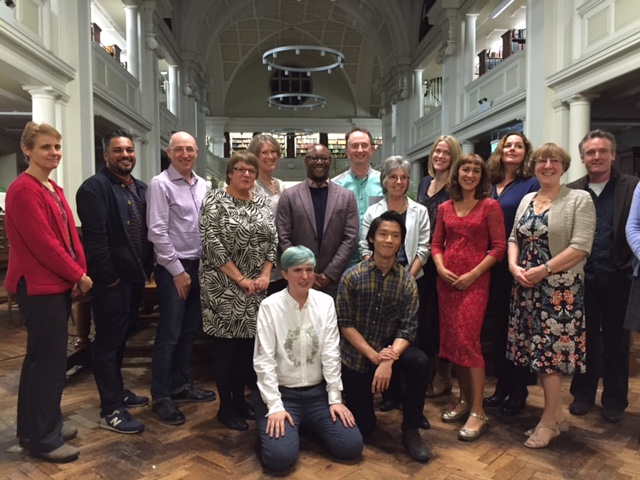
It was my second time at the Bristol Short Story Prize awards ceremony last night. I was hopeful; I was in with a chance after all, among 20 other writers chosen from almost 2,500 entries.

There they were, faces I recognized from last year, organiser Joe Melia, judges Sara Davies and Sanjida O’Connell, and wasn’t that 2013 winner Paul McMichael over there? He’d made the shortlist again. I made a beeline for him and we began laughing in a slightly hysterical, scared kind of way. Still the fear was nothing on last year when – gulp – I could barely speak my mouth was that dry.

Bristol Short Story Prize Writers and Judges

Bristol Short Story Prize Writers and Judges

Us shortlistees sat in the front row in the glass-topped Reading Room at Bristol Central Library. And judge Sara Davies read out the names of the runners-up. Mine was among them.

I hadn’t won.

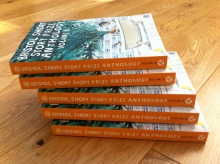
But so what – my story is in a book again – words that I’ve fussed over, changed and rearranged. A story that the early readers and the judges must have connected with somehow. It gets a mention in Sara Davies’ foreword.

‘We all liked….the restrained and powerful exploration of an illegal immigrant’s emotional trauma at the heart of Black Lines,’ she writes.

It was a good feeling reading that. I hope other readers connect with my story too.

BSSP photo

Anthologies galore….

Massive congratulations to Brent van Staalduinen whose story A Week on the Water won first prize, and to the other prizewinners too.

After the ceremony, I spoke to the other shortlisted writers, smiles stretched across their faces, bags bulging with anthologies. (They make very good Christmas presents, let me tell you.) Wine was drunk, woes were shared and successes were well and truly celebrated. I even signed a few books.

It was great to bend Joe Melia’s ear again. His encouragement last year helped steer me through a bout of writing self-doubt. When that strikes again, all I need to do is open up my brand new anthology and remind myself of the rewards for not being a quitter.

Joe also told me that no one in the history of the Bristol Short Story Prize has ever managed a hat trick, so maybe, just maybe I’ll throw my hat into the ring again next year.

https://www.bristolprize.co.uk/shop/

What it’s like to Win a Writing Competition

I started the year with a writing wish list. There were just two things on it: Win a writing competition and find a literary agent to represent my work.

The year’s gone pretty well so far; I’ve had several requests for the full manuscript of my first book, but still no offer. Yet. (I am manically rewriting.)

And then Frome happened – the Frome Short Story Competition. This year, lauded author Samantha Harvey was judging. Oh my, imagine that. I went into full-on dream mode. After much rejigging and rewriting, I entered my story about a migrant worker in Singapore called Plenty More Where You Came From.

Then I carried on redrafting my first novel. Weeks later, an email arrived saying I was in the Frome shortlist. I hadn’t even realised I was in the longlist. Fantastic – something else to say in a query letter to a literary agent.

On Sunday, I headed down the motorway to Frome. Then there it was, the library where the awards ceremony for the competition was going to take place. Other writers, other shortlisted entrants – there were 13 of us – would be there. Samantha Harvey would be there too, and the organisers Brenda Bannister and Alison Clink. There was a fair going on in the car park. A bloke in a mask was poking a rod at a metal head spouting fire, its ears belching steam. I wasn’t sure what that was all about, but my head felt furnace-hot too. God, I wanted to win.

Inside the library, the ceremony kicked off with Samantha Harvey talking about how much she’d enjoyed this year’s shortlist. Choosing first, second and third place hadn’t been easy at all, she said, the stories were that strong. She talked about how writing competitions have become increasingly important in publishing, but that really just writing is the most important thing. Don’t be distracted by not making a shortlist, by not winning, or even by winning – just write.  

Liz Gwinnell took third place with Under the Mango Tree. It was great to put a face to the name – I’d read Liz’s story, Where Hummingbirds Fly, which won third place in Frome back in 2013. That story helped to inspire me to enter Frome this year. I so loved its rich, distinct, voice. Kath Grimshaw won second place with Hotel Room.

Then Samantha described the winning story. An ugly story written with such beauty. Could it be mine? Set in Singapore. Hell, it was mine. Not knowing the names of any of the entrants – the whole thing is judged anonymously – Samantha said the title of my story.

‘It’s me!’ I squeaked and stood up.

I shook hands with Samantha and she handed me my 300 pound prize. And then I read my story out, all 15 minutes of it. And people clapped (thanks for that, people). I walked back to my seat and Samantha’s mum, who was sitting behind me, pumped her fists and said, ‘Well done.’

Frome Short Story Competition, Fiona Mitchell, writer, judge Samantha Harvey

Frome Short Story Competition. 2015 winner Fiona Mitchell and judge author Samantha Harvey

I’d done it, finally a winner.

We spent the next hour in an art gallery next door to the library where many chocolate brownies were chomped and much talk about writing was had. What happens to you when you write? When do you write? Have you written a book? And thanks Liz Gwinnell for wrapping me another brownie for the journey home. I got lost, so that brownie ended up being my tea.

So on winning: Well, it feels brilliant, it really does because someone who’s rated reckons I wrote something beautiful. And now back to the business of writing.

http://www.fromeshortstorycompetition.co.uk/plenty-more-where-you-came-from/